Overview:
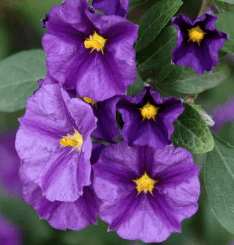 Nightshade flowers generally refer to flowers produced by plants in the Solanaceae family, which includes both edible and poisonous plants.
Depending on the species, these flowers vary in size, color, and structure.
Nightshade flowers come in many varieties, but they typically have five fused petals, are bell-shaped or cylindrical, and are often a vibrant color. Some flowers, like those of tomatoes and eggplants, are small and unassuming, while others, like jimsonweed or belladonna, are large, showy, and often associated with toxicity.
Nightshade flower meaning
The nightshade flower carries rich symbolism and meaning—its mysterious beauty, dual nature (edible vs. poisonous), and historical use in medicine.
Symbolic meanings of nightshade flowers
- Mystery and the unknown
Nightshades often grow in shady, hidden places, and are deep colors like purple or black. They symbolize secrecy, hidden knowledge, and the unseen powers of nature.
- Beautiful but deadly
Many nightshades (such as belladonna and datura) are beautiful but poisonous.
This gives them an air of danger, forbidden beauty, and even seduction.
The nightshade family includes a wide variety of plants, many of which produce distinctive and often beautiful flowers.
Here are some notable types of nightshade flowers:
- Deadly Nightshade (Belladonna)
- Flower Description: Belladonna flowers are bell-shaped and range in color from purple to greenish-white. They grow in clusters and have a distinctive, sweet fragrance.
- Toxicity: Highly toxic. All parts of the plant, including the flowers, contain atropine and scopolamine, which can be deadly in large quantities.
- Tomato (Solanum lycopersicum)
- Flower Description: Tomato flowers are small and typically pale yellow with five star-shaped petals. They grow in clusters and are often self-pollinating.
- Edible Use: The fruit of the tomato plant is widely consumed and is used in many culinary dishes.
- Potato (Solanum tuberosum)
- Flower Description: Potato flowers are star-shaped, with five white to purple petals and yellow stamens in the center.
- Edible Use: Potatoes are a staple food crop, though the green parts of the plant, including the flowers, are toxic due to solanine.
- Eggplant (Solanum melongena)
- Flower Description: Eggplant flowers are typically purple or violet, with yellow stamens in the center. They are solitary flowers, often with a star-shaped appearance.
- Edible Use: The fruit (eggplant) is edible when cooked but should not be eaten raw, as it may contain solanine.
- Tobacco (Nicotiana spp.)
- Flower Description: Tobacco plants have tubular flowers that come in colors like white, pink, red, or purple. They often have a strong fragrance and are attractive to pollinators like bees and hummingbirds.
- Cultural Use: Tobacco leaves are harvested for use in smoking and other products.
- Bell Pepper (Capsicum annuum)
- Flower Description: The flowers of bell peppers are small and white with five petals and yellow anthers.
- Edible Use: The peppers are widely grown for culinary uses in a variety of colors (green, red, yellow, and orange) and can be sweet or spicy, depending on the variety.
- Petunia (Petunia spp.)
- Flower Description: Although not a traditional “nightshade” in the sense of producing edible fruits, petunias are part of the Solanaceae family. They produce large, colorful flowers in shades of purple, pink, red, white, and yellow.
- Ornamental Use: Petunias are commonly grown as ornamental plants for their vibrant and attractive flowers.
- Jimsonweed (Datura stramonium)
- Flower Description: Jimsonweed produces large, trumpet-shaped flowers that can be white, purple, or pink. The flowers are known for their striking, showy appearance.
- Toxicity: This plant is highly toxic, containing tropane alkaloids like scopolamine and hyoscyamine, which can cause hallucinations, delirium, and even death.
- Chili Pepper (Capsicum spp.)
- Flower Description: Chili peppers produce small white flowers with five petals and prominent yellow anthers. These flowers often appear before the fruits begin to grow.
- Edible Use: The peppers are commonly used in cooking to add spice, with varieties ranging from mild to extremely hot.
- Deadly Nightshade (Solanum dulcamara)
- Flower Description: Known also as Woody Nightshade, this plant produces clusters of star-shaped, purple or blue flowers with yellow centers.
- Toxicity: This plant is toxic and can cause digestive distress if ingested.
- Tamarillo (Solanum betaceum)
- Flower Description: Tamarillo plants produce small, star-like flowers that are typically yellow or white, with purple markings.
- Edible Use: The fruit, known as the “tree tomato,” is edible and commonly used in salads or sauces.
- Goji Berry (Lycium barbarum)
- Flower Description: Goji plants produce small, tubular, and often purple or pink flowers with a white base.
- Edible Use: The berries are consumed for their supposed health benefits and are commonly dried or used in smoothies, teas, and desserts.
Is the nightshade flower poisonous?
Many plants in the nightshade family (Solanaceae) can be poisonous, but not all are toxic. Some of the most toxic plants within this family include:
-
Deadly Nightshade (Belladonna) – Atropa belladonna
This is one of the most famous poisonous nightshade plants. Every part of the plant contains toxic compounds, particularly alkaloids like atropine, scopolamine, and hyoscyamine. These compounds can cause hallucinations, dilated pupils, blurred vision, sensitivity to light, tachycardia, and even death if ingested in large amounts.
-
Jimsonweed (Datura stramonium)
Another highly toxic member of the nightshade family, Jimsonweed contains alkaloids like atropine and scopolamine, which can cause delirium, hallucinations, convulsions, and even death.
-
Tobacco (Nicotiana species)
While not immediately poisonous in the same way as Belladonna, tobacco plants do contain nicotine, a toxic substance in high amounts. Nicotine is a powerful neurotoxin and can be fatal if consumed in large quantities.
-
Mandrake (Mandragora officinarum)
This plant is notorious for its use in folklore and contains toxic compounds like hyoscyamine and scopolamine. It can cause nausea, vomiting, and, in severe cases, death if consumed.
However, not all nightshades are deadly. Many commonly consumed plants, like tomatoes, potatoes, eggplants, and peppers, are part of the nightshade family, but are safe to eat when prepared properly. Still, even some edible nightshades can cause discomfort for sensitive people, often leading to conditions like nightshade intolerance or digestive issues.