Angel’s Trumpets (Brugmansia)
Overview:
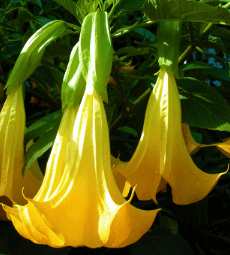 Angel’s trumpets (scientific name: Brugmansia) are a genus of flowering plants, known for their large trumpet-shaped flowers and strong fragrance.
These plants are part of the nightshade family (Solanaceae) and are native to South America. Members of the nightshade family include tomatoes, potatoes, and the related Datura species.
A fact to know is that Brugmansia and Datura are both members of the Solanaceae family (nightshade family). And both share strikingly similar characteristics, especially their large trumpet-shaped flowers.
Let’s discuss the main features of Angel’s Trumpets (Brugmansia) :
Appearance:
The flowers are typically large, funnel-shaped, and can range in color from white to pink, orange, yellow, and sometimes red.
The flowers are highly fragrant, especially at night, adding to their allure.
They are typically hanging or pendulous, which is one of their most distinguishing features.
The leaves are large, broad, and often covered in a fuzzy texture, and the plant itself can grow into a shrub or small tree.
Native Range:
Brugmansia species are native to South America, particularly the Andes region, where they have been cultivated and revered for centuries.
Toxicity:
The entire plant is toxic, containing potent alkaloids such as scopolamine, atropine, and hyoscyamine, which can cause delirium, hallucinations, and even death if ingested in large amounts.
Despite their beauty, Brugmansia plants should be handled with care, as they can be dangerous to both humans and animals.
Cultural and Medicinal Uses:
In some cultures, especially in South America, the plants have been used in shamanistic rituals and traditional medicine.
The hallucinogenic properties of Brugmansia have been utilized in some indigenous practices, though they are also associated with serious poisoning risks.
Angel’s trumpet flower
The angel’s trumpet flower (Brugmansia) is famous for its large, trumpet-shaped flowers, which are very stunning and highly fragrant. Let’s discuss Angel’s trumpet flower in more detail:
1. Shape and Size:
The flowers are usually large, measuring from 6 inches to 12 inches in length, depending on the species and variety.
The shape is cylindrical, resembling a trumpet, which gives it its common name.
They can have a slightly curved appearance, with petals that spread outward when opened, creating a wide bell shape.
2. Color:
White is the most common color for angel’s trumpet flowers: pink, yellow, peach, purple. Some varieties even have a bi-color or gradient effect, where the flower changes color from the base to the tip.
3. Fragrance:
The flowers are well known for their strong, sweet, and intoxicating fragrance.
The scent is usually strongest in the evening and at night, as it attracts pollinators such as moths. Some people even find the scent overwhelming.
4. Bloom Time:
Usually produced between late spring and summer, although in tropical climates, they bloom year-round. The plant flowers in clusters, with several large blooms appearing together, creating a dramatic effect in the garden.
Brugmansia fruit
Brugmansia fruit is not usually as well-known or visually appealing as the large, fragrant flowers. However, it is still an important part of the plant’s life cycle. Brugmansia fruit develops after the flower is pollinated and is usually spiny, green, and looks somewhat like a tomato or capsule.
Let’s discuss the main characteristics of Brugmansia fruit:
Shape and Size:
The fruit is usually round or oval in shape and can be 2-4 inches (5-10 cm) in diameter.
It is often prickly or spiky on the surface, which gives it a distinctive texture.
As it ripens, the fruit usually turns yellow or brown.
Toxicity:
Like the rest of the plant, Brugmansia fruit is highly toxic. It contains the same toxic alkaloids – scopolamine, atropine, and hyoscyamine – found in the flowers, leaves, and seeds. These compounds can be fatal if ingested.
The seeds inside the fruit are particularly dangerous. They can be easily dispersed by animals or water, but they remain a significant source of toxicity.
Symptoms of poisoning from the fruit include hallucinations, delirium, dilated pupils, and cardiovascular distress, similar to the effects of the flowers or leaves.
Function:
The fruit reproduces the plant. When animals or birds eat the fruit, they can disperse the seeds, allowing the plant to reproduce.
However, due to its toxicity, Brugmansia fruit is not usually eaten by humans or animals. In nature, it is mainly the wind, birds, or insects that facilitate the dispersal of the seeds.
Ripening:
The fruit begins as a green, spiny capsule and gradually matures to a yellowish-brown color. When ripe, the fruit may split open and release the seeds. However, this process is rare in cold climates where Brugmansia can be grown as a shrub or container plant.
Warning:
If you have Brugmansia growing in your garden, it is important to be careful with its fruit, especially when it ripens in late summer or fall.
It is very important to ensure that children and pets do not ingest any part of the plant, including the fruit.
Brugmansia poisonous
Brugmansia is a highly toxic plant, with all its parts—flowers, leaves, stems, and seeds—containing harmful alkaloids. These alkaloids belong to the tropane class, which can produce a variety of severe reactions when ingested, inhaled, or absorbed through the skin.
The symptoms of poisoning include extreme thirst, difficulty speaking and swallowing, nausea, vomiting, diarrhea, fever, confusion, hallucinations, delirium, seizures, and in some cases, death.
Toxicity and Symptoms
Hallucinations: Scopolamine and atropine can cause vivid visual and auditory hallucinations.
Dilated pupils: One of the most common signs of poisoning. The pupils may appear large (dilated) and may be sensitive to light.
Dry mouth and throat: A common effect of anticholinergic toxins, which can cause difficulty swallowing and speaking.
Confusion and delirium: Toxic levels of alkaloids can cause confusion, disorientation, agitation, and even memory loss.
Rapid heart rate (tachycardia): The plant’s toxins can cause an increase in heart rate, which can lead to palpitations or arrhythmia (irregular heartbeat).
Urinary retention: Difficulty or inability to urinate is another sign of poisoning.
Severe toxicity: In extreme cases, poisoning can cause seizures, coma, and death.
How poisoning occurs
Eating: Eating any part of the plant, especially the flowers, seeds, or leaves, is the most common route of poisoning.
Skin contact: Alkaloids can also be absorbed through the skin, especially when the plant is handled without gloves.
Inhalation: The strong scent of the flowers, especially if concentrated in an enclosed space, can cause poisoning, although this is less common.
If you are interested in the plant for ornamental purposes, it is important to place it in a location where it will not pose a risk to curious children or pets.
Brugmansia vs Datura
Brugmansia and Datura are two closely related genera in the Solanaceae family (nightshade family), both known for their large, trumpet-shaped flowers and potent, often toxic properties.
Datura and Brugmansia have excellent ornamental qualities and should be used in areas where people and pets will not get too close.
The two are often confused due to their similarities, but they have distinct differences in morphology, growth habit, and toxicity.
-
Genus and Family:
- Both Brugmansia and Datura belong to the same plant family, Solanaceae, and share some similar alkaloids (such as scopolamine, hyoscyamine, and atropine) that contribute to their toxicity. However, they are distinct genera.
-
Growth Habit (Shrub vs. Herb):
- Brugmansia: These plants are typically large shrubs or small trees. They can grow anywhere from 3 to 10 meters (10–33 feet) tall, often with woody stems.
- Datura: Datura species are usually herbaceous perennials or annuals. They tend to be much shorter, usually ranging from 0.5 to 2 meters (1.5–6.5 feet) tall.
-
Flower Shape and Orientation:
- Brugmansia: One of the most distinctive features of Brugmansia is its pendulous flowers. The trumpet-shaped blooms hang down from the branches, giving the plant a drooping, graceful appearance. The flowers are typically large, with lengths of 15–30 cm (6–12 inches).
- Datura: Datura flowers are also trumpet-shaped but are upright (they grow upwards, not hanging down). Datura flowers are generally smaller than Brugmansia’s, often around 5–10 cm (2–4 inches) in length, and can be white, purple, or yellow depending on the species.
-
Flowering Time:
- Brugmansia: Brugmansia blooms primarily in the summer and is known for its strong fragrance, especially in the evening and night.
- Datura: Datura blooms during the night or evening and is typically less fragrant than Brugmansia. It tends to attract nocturnal pollinators like moths.
-
Leaves:
- Brugmansia: The leaves of Brugmansia are generally large, broad, and deep green, sometimes with a slightly hairy texture. They are arranged alternately on the stems.
- Datura: Datura leaves are also large but are typically more angular and often have a somewhat more rough or spiky texture compared to Brugmansia’s smoother leaves.
-
Toxicity:
- Both plants contain toxic alkaloids (such as scopolamine, hyoscyamine, and atropine), which can cause serious poisoning. Symptoms of poisoning include delirium, hallucinations, dilated pupils, tachycardia, and in extreme cases, death.
- Brugmansia: All parts of Brugmansia are toxic, including the flowers, leaves, and seeds. It is sometimes used in traditional rituals for its psychoactive effects.
- Datura: Datura also contains toxic compounds, and its seeds, flowers, and leaves are highly dangerous if ingested. It is often used in folk medicine and some rituals, but like Brugmansia, it carries serious risks.
-
Cultivation:
- Brugmansia: Brugmansia is typically cultivated as an ornamental shrub or small tree in tropical and subtropical regions. In colder climates, it is often grown in pots and brought indoors during winter.
- Datura: Datura is often grown as an annual in temperate climates, though it is a perennial in warmer areas. It is also cultivated for ornamental purposes, often in garden beds, due to its striking flowers.
-
Uses:
- Brugmansia: Sometimes used in traditional medicine and ceremonial contexts, especially by indigenous cultures in South America. Its psychoactive properties have been utilized in spiritual rituals, though it is highly dangerous.
- Datura: Similar to Brugmansia, Datura has been used historically for its psychoactive properties and medicinal purposes, particularly in folk medicine, but its use is extremely risky due to its toxicity.
-
Species Examples:
- Brugmansia Species:
- Brugmansia suaveolens (white-flowered)
- Brugmansia arborea (yellow or white flowers)
- Brugmansia versicolor (pink flowers)
- Datura Species:
- Datura stramonium (common jimsonweed, with white flowers)
- Datura inoxia (with large white or purple flowers)
- Datura metel (purple or white flowers, sometimes referred to as “Horn of Plenty”)
Key Differences:
| Feature | Brugmansia | Datura |
| Growth Habit | Shrub or small tree (3–10 m) | Herbaceous perennial or annual (0.5–2 m) |
| Flower Orientation | Pendulous (flowers hang down) | Upright (flowers point upward) |
| Flower Size | Larger flowers (15–30 cm) | Smaller flowers (5–10 cm) |
| Leaf Texture | Larger, smooth, and softer leaves | Rougher, spiky leaves |
| Toxicity | Highly toxic, all parts are dangerous | Highly toxic, all parts are dangerous |
| Uses | Often ornamental, psychoactive use in rituals | Ornamental, psychoactive use in rituals |